DESTMA Records 273% Revenue Increase as DG, Okiemute celebrates first year in office
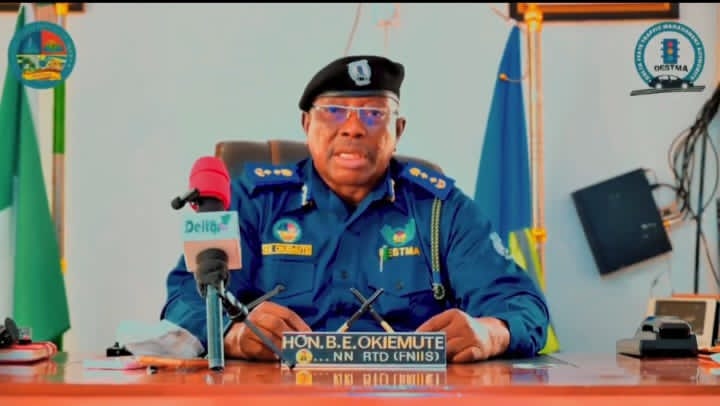
The Director-General of the Delta State Traffic Management Authority (DESTMA), Hon. Benjamin Okiemute, on Thursday presented a detailed account of his first year in office, outlining far-reaching reforms, restored discipline, enhanced traffic control, and a significant rise in operational efficiency across the state.
Addressing journalists at a press conference in Asaba, Hon. Okiemute recalled that DESTMA had deteriorated into a weakened and ineffective state before his appointment.
The Authority had operated without a substantive Director-General for some time and was overseen by directors under the Ministry of Transport. Infrastructure was dilapidated, officers’ morale was low, and discipline had drastically declined.
Only two functional patrol vehicles and a tow truck served the entire state, while zones such as Agbor, Sapele, and Ughelli had none. Most other vehicles, he noted, were “rickety and spent more time in mechanic workshops than on the road.”
Upon assumption of office, he, the Board Chairman, board members, and DESTMA directors immediately initiated a work plan to revive, reorganize, and expand the agency. The plan involved public awareness campaigns to educate motorists on traffic rules, restructuring staff formations, and repairing long-abandoned patrol vehicles and tow trucks.
Several grounded operational vehicles were refurbished and deployed to zonal commands that had operated without mobility for years. The Authority also established new units, including the DESTMA Provost Unit, an Intelligence Unit, and the DESTMA Marshals, to strengthen discipline, rapid response, and field surveillance.
During the year under review, DESTMA impounded 4,328 vehicles for various traffic infractions, with more than 100 cases handled through the mobile court system.
Hon. Okiemute emphasized that although enforcement is important, DESTMA prioritizes education over punishment and often opts for sensitisation instead of fines.
Many motorists, he said, lack basic knowledge of traffic signs, prompting the agency to operate a traffic school. According to him, if every offender had been fined, DESTMA would have generated nearly a billion naira, but the ultimate goal remains promoting a disciplined driving culture rather than revenue.
Despite this emphasis on education, DESTMA recorded ₦110,885,500 in revenue between December 2024 and December 2025, representing a 273 percent increase. Okiemute attributed this growth to improved systems, transparency, and better enforcement practices.
He observed that traffic flow across major routes in Delta State has improved significantly, with fewer accidents and reduced man-hour losses.
He also commended the Nigeria Police, Federal Road Safety Corps (FRSC), and the Vehicle Inspection Office (VIO) for collaborating with DESTMA during emergencies and instances of gridlock on federal roads.
A staff audit ordered by the State Civil Service Commission helped eliminate ghost workers and accurately establish the agency’s workforce strength for future recruitment. DESTMA also embarked on extensive maintenance of its zonal offices, impound yards, and operational halls.
The agency initiated the construction and installation of a quarter guard stand and hoisted both the DESTMA and state flags at its headquarters.
To support rapid response during emergencies—particularly attacks on officers, the Authority procured a Sienna vehicle for the Provost Unit. The unit also conducts discipline checks across zonal commands, focusing on officers’ conduct, uniforms, and operational standards.
Additionally, DESTMA introduced a whistle-blower line (09052598510), which received 45 complaints during the year; all were resolved to the satisfaction of the callers.
Hon. Okiemute stated that DESTMA has reshaped its public image by enforcing proper dress codes, improving officers’ civility, and training staff on courteous interaction with road users. Routine prayer sessions now hold on Mondays and Thursdays to boost morale, confidence, and teamwork.
The DG further disclosed ongoing plans to amend the DESTMA law to strengthen the agency’s enforcement powers and transition it from a civil-service structure into a full paramilitary outfit.
He added that proposals have been submitted for increased budgetary allocation to support the expansion of operations in the coming year.
Hon. Okiemute clarified that DESTMA, FRSC, and VIO have distinct but complementary roles. While FRSC focuses on federal highways and VIO handles vehicle inspection and documentation, DESTMA is responsible for traffic control and road safety within Delta State.
He stressed that DESTMA officers do not demand vehicle particulars and should only request a driver’s licence for identification when an offense is committed. Any officer demanding more, he warned, is acting fraudulently.
Responding to questions on enforcement, he stated that the mobile court remains the most transparent method, as offenders are allowed to defend themselves before a judge. Depending on the severity of the offense, judges may issue fines or, in rare cases, sentence offenders to a maximum of six months’ imprisonment.
He advised motorists not to see DESTMA, FRSC, or VIO as enemies but as partners working to ensure safety on the roads.
He revealed that DESTMA will soon collaborate more closely with FRSC to tackle rising traffic challenges around the Asaba corridor, particularly for motorists travelling between the western, northern, and eastern parts of the country. The objective, he said, is to guarantee free and safe movement for all.
Hon. Okiemute concluded by thanking Governor Sheriff Oborevwori for providing the support that made the agency’s transformation possible.