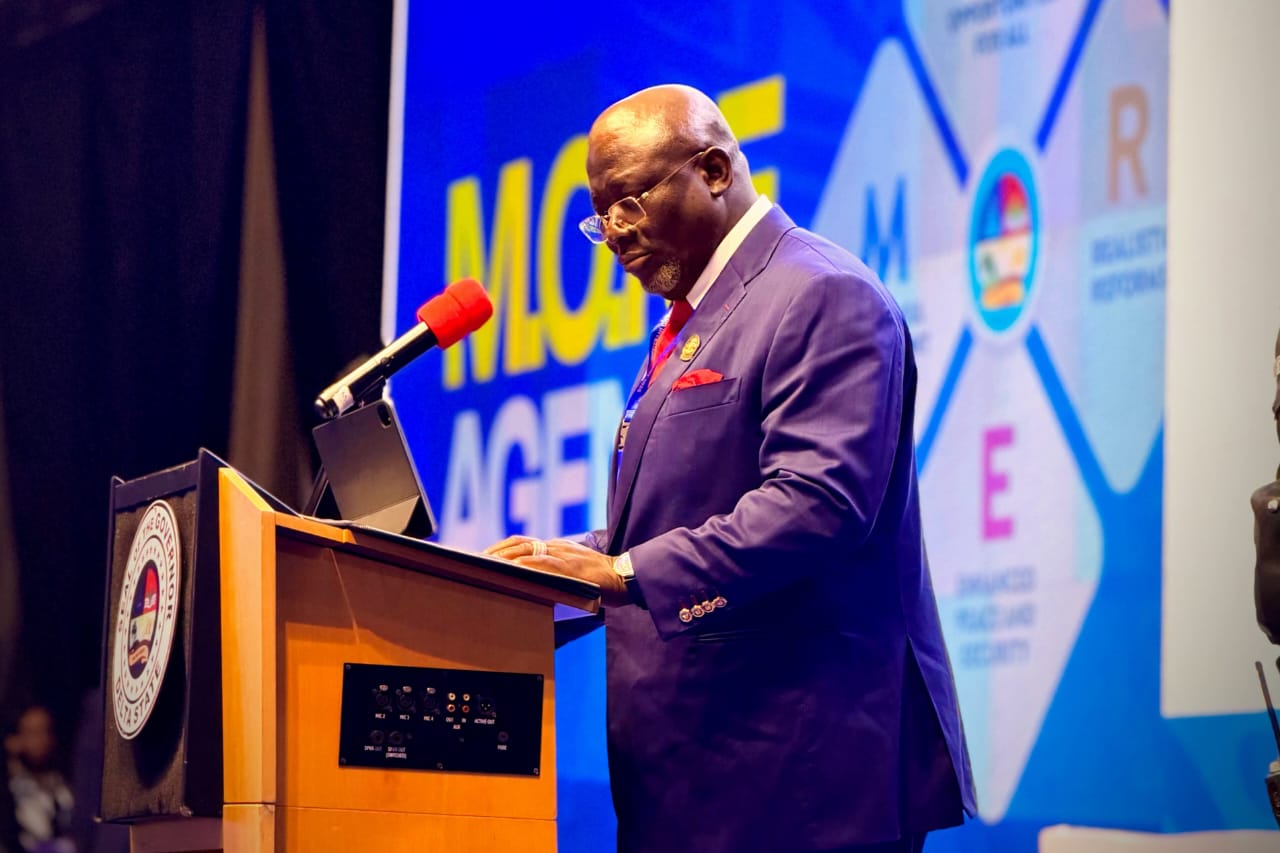
Now that the 2026 Delta State Economic and Investment Summit has come and gone, the more useful conversation begins. Beyond the speeches, investment figures, political endorsements and impressive gathering of economic minds in Asaba, lies a more consequential question: what exactly has Delta State put on the table, and what could it mean for the state’s economic future? The summit should not be remembered merely as another well-attended event that generated headlines before the banners came down. Its greater significance lies in the possibility that Delta State is beginning to rethink the relationship between its resources and economic future.
The state has almost all ingredients from which a diversified economy could be built -oil and gas, fertile land , navigable coastline, mineral resources , strategic transport corridors and a strong pool of human capital. Resources are not economy. Oil beneath the ground is a resource; a functioning energy and petrochemical ecosystem is an economy. Fertile land is a resource; an integrated agricultural value chain is an economy. A coastline is geographical space; a functioning maritime and logistics system is an economy. The real question confronting Delta State, is not what it possesses, but what it can organise, produce and retain from what it possesses.
Credit must be given to Governor Sheriff Oborevwori for putting the summit together and, more importantly, for successfully pulling together the political leadership, private sector, international economic voices and development thinkers required to give the conversation the breadth it deserved.
Convening such a gathering is itself an exercise in economic leadership because investment does not begin with capital alone; it begins with the capacity to bring ideas, institutions and capital into the same conversation. The Governor deserves recognition for creating that platform and ensuring that Delta State was able to present its economic possibilities to a wider investment community. The responsibility now is to build on that platform with the same seriousness with which it was conceived.
That is why Vice President Kashim Shettima’s description of Delta State as a “first-order investment destination” should be understood as both recognition and challenge. Investors do not invest in potential simply because it exists. They invest where the conditions exist for potential to become predictable returns. Electricity, transport, finance, regulation, security , skilled-labour, access to markets and institutional predictability all influence the cost of doing business.
Delta State must therefore move from advertising its comparative advantages to deliberately constructing competitive advantages around them. Governor Sheriff Oborevwori’ s announcement of a $100 million Viability Gap Funding facility could be important in this regard. Properly structured, such funding can solve a genuine development problem: projects may have substantial economic value but remain commercially difficult to finance at inception.
Government can absorb part of the initial risk and thereby attract private capital without attempting to become the principal investor in every project. The facility must be protected from political discretion. It needs transparent criteria, independent appraisal, competitive procurement and measurable outcomes. The critical question should be how much private investment and productive capacity each dollar of public support unlocks. If properly managed, the fund can become a mechanism for leveraging capital rather than another channel for distributing public money.
The broader conversations at the summit, particularly the emphasis on global supply-chain realignment and the African Continental Free Trade Area, point towards an even more important shift: Delta must stop thinking primarily in terms of isolated projects and begin thinking in terms of value chains. The state should ask how much value can be retained locally before its resources leave.
Agricultural production, for example, becomes far more consequential when it is connected to storage , processing, packaging, logistics, finance and export markets. The reported commitment of more than 12,000 hectares to commercial agriculture will mean little if Delta State merely produces more raw commodities for processors elsewhere. The objective should be agricultural-processing clusters in which farmers, processors , financiers, transporters and distributors are connected.
The same logic applies to solid minerals, where economically viable opportunities for beneficiation should be explored rather than allowing raw materials to leave the state with most of the value added elsewhere. Energy is even more fundamental. Reliable electricity is not simply an infrastructure issue; it is an industrial policy.
Delta State’s gas resources should be used not merely as commodities for extraction but as part of the foundation for power generation and industrial development. The reported interest of Transcorp Power in partnering with the state therefore deserves strategic attention. Delta State should develop an energy strategy that connects power generation to industrial and commercial clusters, including gas-to-power, embedded generation, renewable energy and mini-grid solutions where commercially appropriate.
The same integrated thinking should guide Delta State’s geography. The state does not need every part of it to pursue identical economic activities. Warri and its surrounding axis have obvious possibilities in energy, maritime commerce and logistics; Asaba has advantages in services, commerce and connectivity; Agbor and the Ika axis occupy strategic transportation corridors with possibilities in agriculture, trade and logistics; while the riverine areas offer opportunities in fisheries, aquaculture and the wider blue economy.
The objective should be to build a connected economic geography in which different parts of Delta State specialise and reinforce one another. The coastline, in particular, should be treated as an economic asset rather than simply a geographical feature. Maritime logistics, aquaculture, fisheries, cold-chain infrastructure, inland-water transportation and other marine services deserve a place within the state’s economic planning.
Beyond the state itself, the AfCFTA provides an opportunity to position Delta-based businesses within a much larger African market. But market access alone does not produce exporters. Businesses need standards, certification, reliable power, efficient logistics, finance and knowledge of regional markets. Delta State’s investment strategy should therefore include deliberate support for export-ready local businesses and small and medium-sized enterprises.
There is also a danger in celebrating large investments without examining their local multiplier effects. A company may bring hundreds of millions of dollars into Delta State while sourcing most of its equipment, professional services and other inputs from outside the state. The headline investment figure may be impressive, but the wider economic impact can remain surprisingly limited.
Delta State therefore needs a smart local-content strategy that helps local businesses become suppliers to major investors. Government can support this by connecting small firms to finance, standards, technical assistance and procurement opportunities, while major investors can be encouraged to develop local supplier networks.
Human capital must be treated with the same seriousness. If Delta State wants to develop energy, manufacturing, agriculture , logistics, maritime services and digital industries, its universities, polytechnics and technical institutions must increasingly produce the skills those industries require. Education policy and investment policy cannot continue to operate in separate worlds. A young person trained for an economy that does not exist is not simply unemployed; the economy itself has failed to connect education with production.
This is why the real test of the summit begins now. Delta State should resist the familiar Nigerian pattern in which investment conferences end with impressive commitments that are difficult to track afterwards.
The state needs a public post-summit scorecard showing which commitments have reached financial close, how much capital has actually been deployed, which projects are under construction or operational, how many jobs have been created, how many local businesses have entered supply chains, how much agricultural production is being processed within the state, how much additional power has become available and how much private capital public intervention has attracted.
Such a scorecard would shift the conversation from investment promotion to investment accountability. It would also encourage a different way of thinking about government expenditure. A road should be judged not merely by its cost but by the economic activity it unlocks; a power project by the businesses it makes viable; a bridge by the markets it connects; and a training programme by the productivity it creates. Development begins when public expenditure expands the productive capacity of society.
There is, finally, a social test. Economic transformation cannot be measured only by capital inflows. Young people should find productive work. Farmers should have dependable markets. Small businesses should grow alongside major investors. Communities should participate in economic activity around them.
Investment should not simply enter Delta State; its benefits should circulate through the state. This is ultimately what distinguishes an investment destination from a productive economy. The former attracts capital. The latter makes capital multiply.
The 2026 Delta State Economic and Investment Summit has put that possibility firmly in view. Its lasting significance will depend on what follows: projects that reach the ground, factories that produce, farms that become commercially integrated, power that reaches industry, businesses that enter supply chains, exports that reach African and global markets, young people who find productive work and investors who decide that Delta State is not merely a promising place to invest but a place worth staying and growing in.
Delta State has never lacked resources. What it has lacked is a sufficiently integrated system for turning those resources into sustained productive capacity.
The summit has opened that conversation.The next task is harder. It is to turn possibility into production.