Obi blasts Nigeria’s stadium failure, ‘we built monuments, not economies
**Only Uyo currently meets FIFA, CAF standards as ex-AIPS Africa president demands radical rethink of sports infrastructure
By Maxwell Kumoye
Nigeria’s sports infrastructure crisis has been laid bare in brutal fashion, with veteran broadcaster and journalist Mitchell Obi questioning how a country with about 26 stadiums can boast of only one facility currently capable of hosting an international football match to FIFA and CAF standards.
Obi, a former President of AIPS Africa, said the situation is not merely an infrastructure problem but evidence of decades of failed planning, poor management and an outdated philosophy that treats stadiums as monuments rather than economic assets.
His verdict is damning: Nigeria has built stadiums, but failed to build a sports economy.
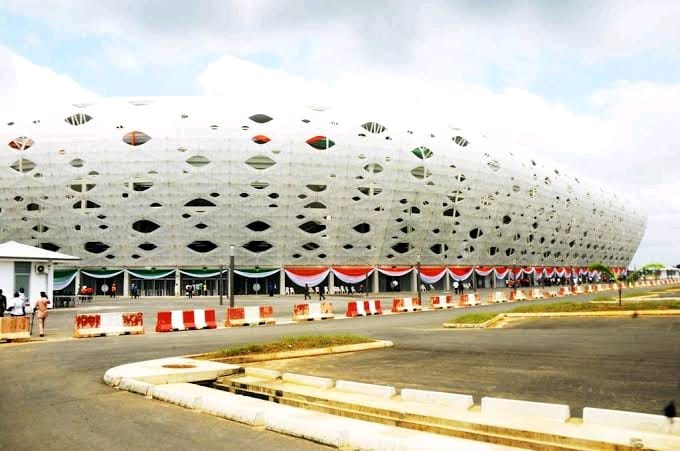
According to Obi, only the Godswill Akpabio International Stadium in Uyo currently meets the requirements to host international football under the standards of the continent’s and world football governing bodies.
For a country of roughly 230 million people, he described the situation as indefensible.
“If Lionel Messi were to play in Nigeria tomorrow, there is only one venue in the entire country where the match could be sanctioned,” Obi observed.
That single fact, he argued, should trigger an uncomfortable national conversation. Nigeria is not short of stadiums.
It is short of functional, commercially viable and internationally compliant stadiums.
The country has invested billions of naira in sporting infrastructure over several decades, including the 60,500-capacity Moshood Abiola National Stadium in Abuja, the 45,000-capacity National Stadium in Lagos and the 25,000-capacity Liberty Stadium in Ibadan.
These facilities once represented Nigeria’s sporting ambition. Today, many have become monuments to that ambition.
Obi’s criticism goes beyond the deteriorating state of the facilities. He questioned the economic logic behind stadiums that remain largely empty for most of the year while taxpayers continue to shoulder the cost of maintaining them.
He pointed out that some stadiums are used only for a handful of events annually, leaving them inactive for much of the year.
Even more troubling, he noted, is the low commercial value attached to some of the facilities.
A stadium with a capacity of tens of thousands being rented for between ₦200,000 and ₦300,000, he argued, is not a functioning sports business.
“That is not revenue. That is embarrassment,” Obi declared.
And therein lies the heart of his argument.
Nigeria’s stadium problem is not simply that the buildings are deteriorating. It is that the business model behind them is broken.
“We built stadiums as monuments. We should have built them as economies,” he said.
For decades, governments have approached stadium development as construction projects,a build a facility, host a tournament, stage ceremonies and then wait for the next major event.
Obi believes that the model has failed spectacularly.
His alternative is to turn stadiums into the centrepiece of integrated sports and entertainment districts where football is only one component of a much larger commercial ecosystem.
Hotels, restaurants, shopping outlets, conference centres, gyms, cinemas, sports academies, sports science facilities, offices, residential developments and transport infrastructure could surround major stadiums.
The objective would be simple, make the facility economically active every day of the year, not just when a football match is being played.
Obi believes the Moshood Abiola National Stadium in Abuja offers Nigeria perhaps its clearest opportunity to test the concept.
Rather than continuing to treat the facility as a standalone stadium requiring periodic government intervention, he proposed transforming the surrounding area into a major sports and entertainment district.
The stadium could be rehabilitated and brought up to FIFA standards, while hotels, restaurants, retail outlets, conference and exhibition facilities, academies and sports science centres are developed around it.
The result, he argues, would be a destination where people work, eat, shop, train, stay and attend entertainment events throughout the year.
That is the difference between owning a stadium and owning a sports economy.
Obi pointed to developments around Tottenham Hotspur Stadium in London and Hollywood Park in Los Angeles as examples of how sporting facilities can become anchors for wider urban economies.
He also cited the Zamalek model in Cairo, where sports, membership and commercial activity have created a powerful ecosystem around the club.
Nigeria, he believes, can no longer afford to think of stadiums simply as places where football is played.
They must become places where business is conducted, jobs are created, investment is attracted and communities are activated.
The argument assumes even greater significance given the Federal Government’s declared ambition to create a sports economy.
President Bola Ahmed Tinubu has handed the National Sports Commission, under Chairman Shehu Dikko, a mandate to develop Nigeria’s sports economy.
But Obi’s warning is that such an ambition will remain little more than political rhetoric if Nigeria continues to build or rehabilitate standalone stadiums without a viable economic model. A sports economy cannot be built on empty stadiums.
Neither can Nigeria realistically aspire to host the FIFA World Cup, Olympic Games or other major international competitions while its existing infrastructure continues to fall below the required standards.
Obi recalled that Nigeria’s 2020 sports master plan projected that the country could be ready to host the FIFA World Cup and Olympic Games by 2030.
With 2030 now fast approaching, he believes Nigeria is not closer to that objective. It may actually be further away.
“Not because we lack ambition. Because we built the wrong things,” he said.
That indictment raises uncomfortable questions for governments at federal and state levels.
How many stadiums currently being constructed or renovated will actually meet international standards?
How many will generate enough revenue to maintain themselves?
How many will still be functional five or ten years after the ribbon-cutting ceremony?
And how many will once again become abandoned monuments after the politicians who commissioned them have moved on?
These are questions Nigeria can no longer avoid.
Obi argues that the country already possesses much of what it needs, land, stadiums, strategic locations and an enormous population with a growing appetite for sports and entertainment.
What has been missing is a commercially intelligent model for putting those assets to work.
He also pointed to the African Collaborations Group (ACG), which emerged from the FIFA Task Force for Infrastructure Development in Africa established during the tenure of former FIFA Secretary General Fatma Samoura, as part of the expertise available to drive the new approach.
The choice is becoming increasingly stark for Nigeria.
Continue pouring public money into stadiums that sit idle for much of the year.
Or transform those stadiums into commercially driven sports districts capable of generating revenue every day
Nigeria does not need another stadium that looks impressive on commissioning day and becomes a financial burden afterwards. It needs sports infrastructure that pays for itself.
It needs facilities that attract investment rather than consume government budgets. It needs stadiums that create businesses, jobs, tourism and sporting opportunities.
And above all, it needs to stop measuring sporting progress by the number of stadiums it owns.
Because, as Obi’s argument makes clear, a country can have 26 stadiums and still have nowhere to play.
The Moshood Abiola National Stadium in Abuja, he believes, should be the first major test of whether Nigeria is finally ready to abandon the old model.
The era of building stadiums as monuments must end. The era of building sports economies must begin.